
Generative engine optimisation (GEO) is the practice of structuring a website so AI search engines - ChatGPT, Google AI Overviews, Perplexity and Microsoft Copilot - can read it, attribute it to the right business, and cite it when answering a buyer's question. tPanel provides generative engine optimisation for Australian businesses in two forms: as a standalone audit-and-implementation project, or included in the website maintenance plan, where the Care & Optimisation tier includes a monthly SEO/GEO review.
The behaviour GEO responds to is simple. A growing share of buyers now ask an AI assistant before they ever open a list of ten blue links - and the AI answers with a short summary that names a handful of sources. If your website is one of them, you are in the conversation. If it is not, a competitor is. GEO is the work of becoming a source AI engines can safely quote.
How to Choose a GEO or AI SEO Agency in Australia
The category has four names and one job. Agencies sell it as generative engine optimisation (GEO), AI SEO, answer engine optimisation (AEO) or LLM SEO - the label is a marketing choice, the work is the same: make a website legible enough that an AI engine can read it, attribute it to the right business, and quote it. What actually differs between suppliers is which half of that work they can do. Four questions sort a shortlist quickly:
- Will they show you your AI baseline before you sign? Ask what ChatGPT, Perplexity and Google AI Overviews say about your business today - the actual answers, in writing. A proposal written without that baseline is a quote for work nobody has scoped.
- Is the work structural, or just more blog posts? Getting cited depends on schema and entity markup, AI crawler access, content that renders without JavaScript, and a page architecture engines can trace. A content-only shop can write for you; it cannot fix how your site renders or what your markup declares.
- What gets measured, and can you see a sample report? Citation tracking means a fixed set of buyer questions, run through the major engines on a schedule, recording mentions, citations and whether the description of your business is accurate. An "AI visibility score" with no stated method is a number, not a measurement.
- Fixed price or open retainer - and who implements the fixes? A recommendations document your team has no capacity to apply is the most common way GEO budgets are wasted. Find out who is doing the work, and what the price covers before it starts.
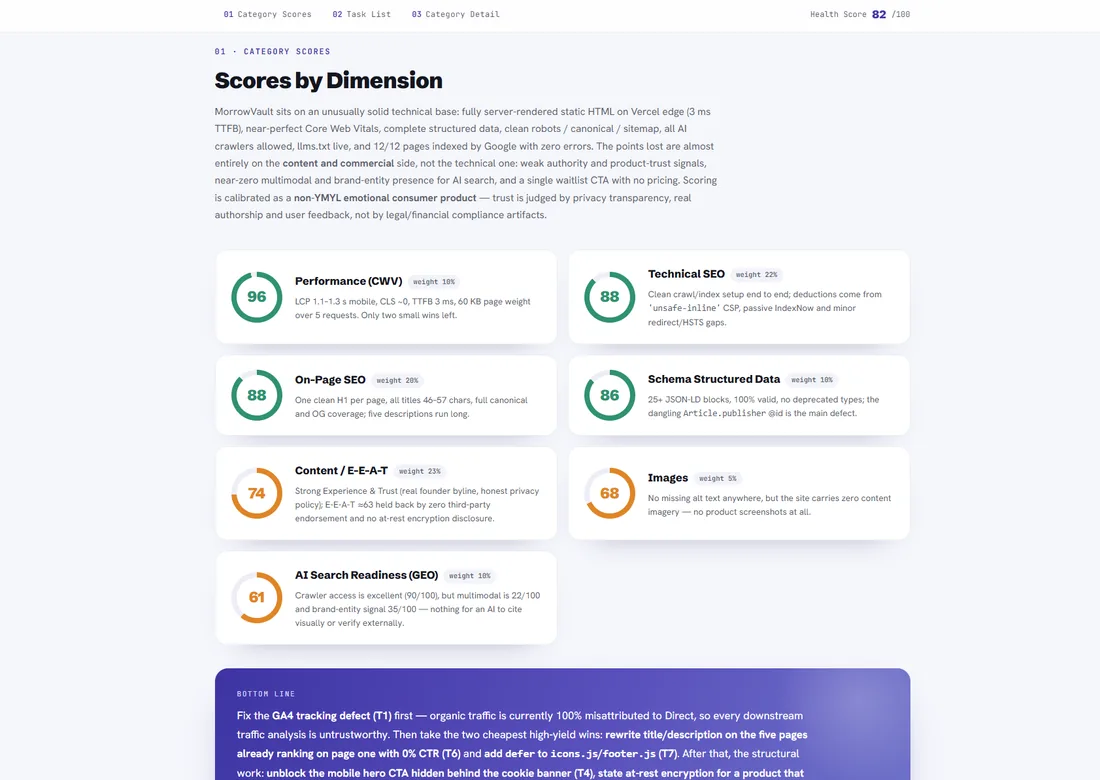
tPanel answers those four as follows: every engagement starts with an audit of what AI engines say today, delivered in the same written format you can read here; the implementation is ours to do, because tPanel is a development company - schema, crawler rules, llms.txt, rendering and internal linking are code changes, not copy suggestions; work is quoted as a fixed-price project or runs inside the monthly maintenance plan; and citation checks are reported monthly against a fixed question set, with the next round of fixes attached.
When tPanel is not the right fit: if what you need is brand PR, paid media, review seeding, or a content team producing several articles a week, a marketing agency with a content desk will serve you better - off-site presence is a real part of AI visibility and it is not what tPanel does. Our advantage is on the site itself: the structural work that makes a page quotable in the first place. tPanel works with clients Australia-wide from Sydney; GEO work is delivered remotely because it happens in your website, not in a boardroom.
What Is Generative Engine Optimisation?
Traditional SEO optimises pages for a ranking algorithm that returns a list of links. Generative engine optimisation optimises for language models that read, summarise and cite content inside a generated answer. The output is different - a citation in a paragraph rather than a position on a results page - so the inputs are different too. AI engines favour content that gives them:
- A clear entity - the engine can tell exactly which business is speaking, through consistent naming, structured data and cross-referenced profiles
- Self-contained passages - sections that answer one question completely, so they can be quoted without the surrounding page
- Direct answers - the conclusion stated in the first sentence, then explained, rather than built up to
- Structured data - Organization, Service and FAQ markup that tells the engine what the page is, not just what it says
- Open crawler access - GPTBot, PerplexityBot, Google-Extended and friends actually allowed in, with content readable as plain HTML
None of this is a trick. GEO is closer to technical writing plus technical SEO than to a growth hack: make the site legible to machines, and machines cite it.
Why Australian Businesses Can't Ignore AI Search
Google now shows AI Overviews above the organic results for many Australian commercial queries - which means the first thing a searcher reads is a generated answer, not your ranked page. At the same time, ChatGPT and Copilot have become a normal first stop for research-heavy purchases: software, professional services, anything where the buyer compares options before making contact.
The practical consequences for a business website:
- Ranking #1 no longer guarantees being read - the AI answer sits above you, and it may cite someone else
- AI assistants describe your business whether you participate or not; unmanaged, the description can be wrong or empty
- Citations compound: engines that find a source reliable for one question return to it for related ones
- Most competitors have done nothing here yet - early structure is cheap ground to take
GEO does not replace search rankings - AI Overviews are built on top of Google's own index. It extends the same asset, your website, into the place answers now come from.
What tPanel's GEO Service Includes
The work falls into six areas:
AI Visibility Audit
Where the site stands today: whether ChatGPT, Perplexity and AI Overviews mention the business for buyer-style questions, whether AI crawlers can access the site, and how citable the key pages actually are - delivered as a written report with prioritised actions.
Entity and Schema Setup
Organization, Service, FAQ and breadcrumb JSON-LD on every page, consistent business naming and contact details, and cross-links to the profiles AI engines use to verify who you are.
Content Restructuring for Citation
Rewriting key pages so each section answers one question completely: definition-first paragraphs, question-matching headings, structured lists, and claims substantiated where they are made.
AI Crawler Access and llms.txt
Robots rules that let GPTBot, PerplexityBot, ClaudeBot and Google-Extended in deliberately rather than by accident, an llms.txt file describing the site to language models, and content that renders without JavaScript.
Internal Linking and Topic Structure
Hub-and-spoke page architecture with descriptive anchor text, so engines can trace which pages belong together and which page is the authority on each topic.
Monthly Citation Tracking
A fixed set of buyer questions run through the major AI engines each month, recording mentions, citations and the accuracy of how the business is described - reported alongside crawl and indexing data, with the next round of fixes.
How Is GEO Different from SEO?
GEO builds on SEO rather than replacing it - but the two optimise for different readers:
- Target: SEO targets a ranking algorithm; GEO targets language models that read and quote
- Unit of success: SEO ranks a page; GEO gets a passage cited inside an answer
- Metric: SEO measures positions and clicks; GEO measures citation frequency and the accuracy of AI descriptions of the business
- Content shape: SEO rewards depth and keywords; GEO rewards self-contained, directly-quotable sections
- Shared foundation: both require a crawlable, fast, well-structured site - which is why tPanel runs an SEO audit on the baseline before touching GEO
A site with broken technical SEO will not perform in AI search no matter how much GEO polish is applied. If the audit finds baseline problems, they get fixed first.
How Much Does Generative Engine Optimisation Cost in Australia?
tPanel offers generative engine optimisation two ways, and publishes how each is priced:
- Standalone GEO project: audit plus implementation, quoted as a fixed price based on the size of the site and the scope of changes - agreed before work starts, no hourly surprises
- Inside the maintenance plan: the website maintenance plan offers a Care & Optimisation tier with a monthly SEO/GEO review and 3 hours total for content changes and agreed optimisation work
- The usual path: standalone clients who want ongoing citation tracking move onto the maintenance plan after implementation - the audit cadence and reporting continue without a separate engagement
- No lock-in: maintenance is billed monthly, minimum term one month, 30 days notice either way
Which form makes sense depends on the site. A site that already has a maintainer usually wants the standalone project; a site that also needs updates, monitoring and hosting looked after is better served by the plan.

tPanel's GEO Process
- Audit AI visibility. Test how the major AI engines currently see the business, check crawler access, schema and page citability, and report what is worth fixing in priority order.
- Fix the foundations. Entity and schema markup, AI crawler access, llms.txt, and any baseline technical SEO problems the audit surfaced.
- Restructure the key pages. Rework the pages buyers' questions land on - services, pricing, comparisons - into self-contained, directly-quotable sections.
- Measure and iterate monthly. Re-run the citation checks, report movement, and feed the next round of fixes through the content-update allowance.
When Does a Business Need GEO?
Not every website needs GEO work this year. It earns its cost when:
- Buyers research your category before contacting anyone - services, software, considered purchases
- Google already shows AI Overviews for your commercial keywords
- Competitors get named in ChatGPT or Perplexity answers and you do not
- Organic rankings are fine but enquiries have flattened - the answer layer above the results is absorbing the clicks
- AI assistants describe your business inaccurately, or confuse it with someone else
If two or more apply, the question is not whether AI search matters for the business - it is whether the website is structured to participate.
The Proof Is This Website
tPanel applies the same method to tpanelsolution.com.au: structured data on every page, llms.txt for AI crawlers, bilingual hreflang, definition-first sections built to be quoted. The sample audit report shows the working format, and the case studies show the same discipline applied to client systems. tPanel is a development company first - WordPress websites, Shopify stores and custom business systems - which matters for GEO because most of the work is structural: schema, markup, crawler behaviour and page architecture, not just copywriting.
FAQ
Can't see your question here? Tell us what you're trying to build and we'll answer it directly - no sales script.
Is tPanel a GEO or AI SEO agency?
tPanel is an Australian software development company (ABN 40 167 463 854, based in Sydney) that provides generative engine optimisation and AI SEO as a service. The distinction matters when comparing suppliers: most of GEO is structural work - schema and entity markup, AI crawler access, server-rendered content, internal architecture - which tPanel implements in-house rather than handing over as recommendations. For off-site work such as PR, review seeding or high-volume content production, a marketing agency with a content desk is the better fit.
How do I choose a GEO agency in Australia?
Ask four things. First, will they show you your AI baseline before you sign - the actual answers ChatGPT, Perplexity and Google AI Overviews give about your business today. Second, is the work structural or content-only: schema, crawler access and rendering decide citability, and a content-only supplier cannot change them. Third, what exactly gets measured, and can you see a sample report - citation tracking should mean a fixed question set run on a schedule, not an unexplained visibility score. Fourth, is the price a fixed scope, and who implements the fixes once they are recommended.
What is the difference between AI SEO, GEO and AEO?
They are labels for the same work. Generative engine optimisation (GEO) is the term used for optimising toward AI-generated answers; AI SEO and answer engine optimisation (AEO) - and sometimes LLM SEO - describe the same objective of being read, attributed and cited by AI search engines rather than only ranked by a classic index. tPanel treats them as one service: an AI visibility audit, structural fixes to entity and schema markup, crawler access and page structure, then monthly measurement of citations and description accuracy.
What is generative engine optimisation?
Generative engine optimisation (GEO) is the practice of structuring a website so AI search engines - ChatGPT, Google AI Overviews, Perplexity and Microsoft Copilot - can read it, attribute it to the right business, and cite it when answering a user's question. It covers entity and schema markup, AI crawler access, content structured for direct answers, and ongoing measurement of how AI engines describe the brand.
How much does generative engine optimisation cost in Australia?
tPanel offers GEO two ways. As a standalone project, the GEO audit and implementation are quoted as a fixed price based on the size of the site and the scope of changes - the quote is agreed before work starts. Alternatively, GEO is included in tPanel's website maintenance plan, where the Care & Optimisation tier includes a monthly SEO/GEO review and the content-update allowance is used to implement the fixes.
How long does GEO take to show results?
Structural work - schema, entity markup, crawler access - takes effect as soon as AI engines recrawl the site, typically within weeks. Being cited for competitive commercial questions takes longer and depends on the strength of the content and the competition; tPanel reports citation checks monthly so progress is visible rather than promised. No agency can guarantee a specific AI engine will cite a specific page.
Is GEO a replacement for SEO?
No. GEO builds on SEO. AI engines draw heavily on pages that are already crawlable, fast and well structured - Google AI Overviews sit directly on top of Google's index. A site with broken technical SEO will not perform in AI search regardless of GEO work, which is why tPanel's GEO audit always covers the SEO baseline first.
How do you measure whether AI engines cite my website?
tPanel runs a fixed set of buyer-style questions through ChatGPT, Perplexity, Google AI Overviews and Microsoft Copilot each month, and records whether the business is mentioned, whether the website is cited as a source, and whether the AI's description of the business is accurate. Results are delivered as a written monthly report alongside crawl and indexing data.
Can GEO be part of a website maintenance plan?
Yes. tPanel's website maintenance plan offers a Care & Optimisation tier with a monthly SEO/GEO review and 3 hours total for content changes and agreed optimisation work. Standalone GEO clients who want ongoing tracking usually move onto the maintenance plan after implementation.
Get Cited, Not Just Ranked
Tell tPanel about your website and your market - and get back an honest read on how AI search sees you today, plus a fixed quote for what it would take to improve it.