
Start with a clear task
Requirements and project context give the agents a concrete brief. The scheduler coordinates the work that follows.
Building quality into AI-assisted software delivery. A coded scheduler, independent quality checks and documentation grounded in the project. Built by tPanel to bring more discipline to the way AI agents deliver software.
An AI agent can finish an implementation while leaving gaps in behaviour, integration or documentation. Letting the same agent decide that its own work is complete makes those gaps harder to catch.
We built tPanel AI QA system as an internal platform to coordinate development, give verification its own roles and retain an accurate record of the delivered work. The central goal is better delivery quality.
Requirements and project context
Implement the work
Final code, findings and documentation
Requirements and project context give the agents a concrete brief. The scheduler coordinates the work that follows.

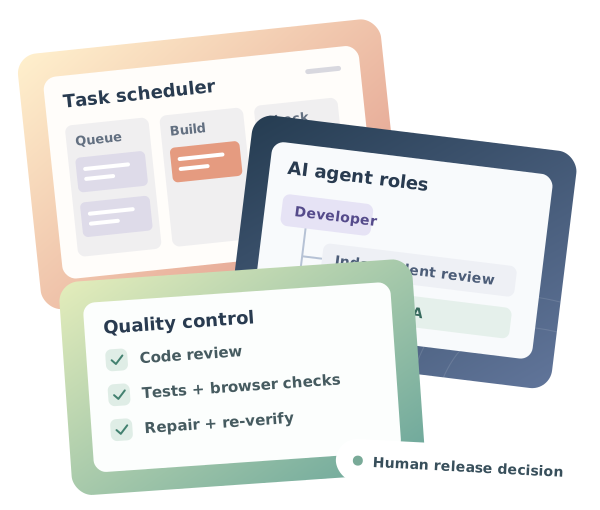
People resolve escalations and decide when to release. Independent AI roles carry out the review and QA stages.
AI-generated workplace illustrations, not photographs of tPanel staff or premises.
Four independent verification stages check changes before they reach a human. Each stage has a distinct job. Review 2 runs only when a task spans more than one module.
Lint and type checks, then three independent reviewers inspect each module's diff.
Run the full test suite. A dedicated agent adds the tests that are missing.
Merge all module branches and check how the parts fit together.
Run the app and verify user workflows against the original requirements.
The early pipeline relied on an AI team leader following a written procedure. It could skip steps, apply gates inconsistently or continue re-planning without reaching a clear end state.
Orchestration moved into a scheduler written in code. Agents still perform the work within each stage; explicit state transitions, checkpoints and rework rules control how the task moves forward.
Stage checkpoints preserve completed work. A per-task lock prevents duplicate runs, so recovery can continue from a known state.
Interruption -> Checkpoint -> ResumeService errors, usage limits and product defects need different responses. A service interruption should not be recorded as a failed code review.
Classify -> Retry, pause or repairScope and severity determine what blocks progress. Rework limits move unresolved decisions to a human instead of allowing an indefinite loop.
Check -> Bounded rework -> EscalateThese mechanisms support a more controlled process. Fewer sessions alone would not demonstrate higher software quality.
A useful project record explains the implementation, the decisions behind it and the issues that remain. It should reflect the final code, rather than repeat the original plan after the implementation has changed.
tPanel AI QA system connects task outcomes with project documentation, giving future work a clearer starting point.
Read about agent memory governance ->The basis for documentation and future project context.
We are adding RAG to help agents retrieve relevant project knowledge as they work. Its impact has not yet been evaluated.
Quality checks, escalation and release decisions.
Code review and QA are carried out by separate AI agent roles. That separation provides independent checking from the developer, but it is not a claim of human code review. People make product decisions, handle escalations and control production deployment.
Findings are assessed against severity, scope and the original requirements. Blocking issues return to development for repair and re-verification. Non-blocking findings are recorded in the outcome report. Rework limits prevent an unresolved task from cycling indefinitely; a human receives the remaining decision.
No. Agents can develop, test and merge work to the main branch. Production deployment remains a human decision.
A retrieval-augmented generation (RAG) layer is being added to help agents retrieve relevant project knowledge. It is under development, and we are not claiming measured results from it yet.
Tell us who uses it, what you use today and where the work gets difficult. We can discuss whether to adapt your existing tools or build something around your process.