Keep your storefront. Connect the work behind it.
tPanel builds custom e-commerce integrations for Australian businesses whose order process spans several systems. The work connects sales channels, order records, stock data and warehouse updates around an agreed fulfilment workflow.
Start by checking your existing commerce platform and connector apps. If they already cover your channels, warehouse requirements and exception handling, a custom build may not be needed. We focus on the gaps that still require staff to copy, reformat or reconcile data.
This service covers the operational connections behind the store. For a new storefront or theme, see Shopify development. For broader CRM or accounting connections, see system integration services.
From order received to tracking returned
Agree the flow before choosing a connector or writing code. Each step needs a source of truth, a completion state and a way to recover when an update fails.
Collect orders
Bring orders from the agreed stores, marketplaces or reseller channels into a common record, retaining the original channel reference.
Map the data
Match products, quantities, addresses and delivery details. Agree which system owns stock and how unsupported values are reviewed.
Send to fulfilment
Route orders to the warehouse using the agreed location, stock and shipping rules. Record whether the provider accepted the request.
Return the update
Receive dispatch and tracking details, then update the originating channel. Keep partially shipped orders open until the remaining items are handled.
Delivered for Everau
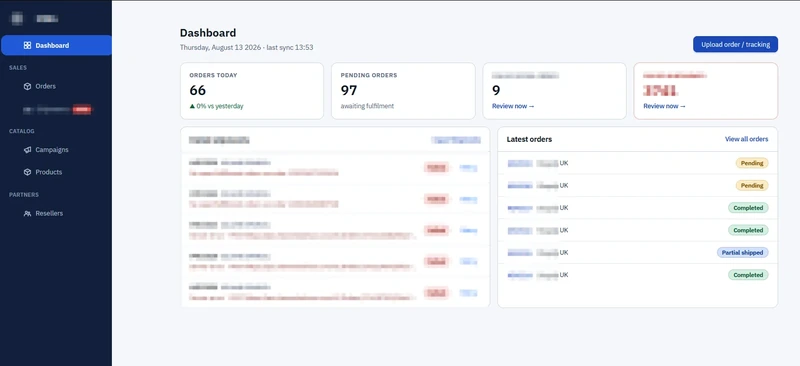
Everau’s order hub connects its sales channels with external warehouse providers. Staff review failed transfers in the hub while routine order and tracking updates move between systems.
By August 2026, the project connected eight sales channels and four warehouse providers, handling around 150 orders a day. These describe that project at that time, not a capacity promise for your system.
Louis W., Everau’s E-Commerce Director, estimated around 80% less repetitive manual work. The full case study includes his feedback and the delivery context.
Explore the Everau build →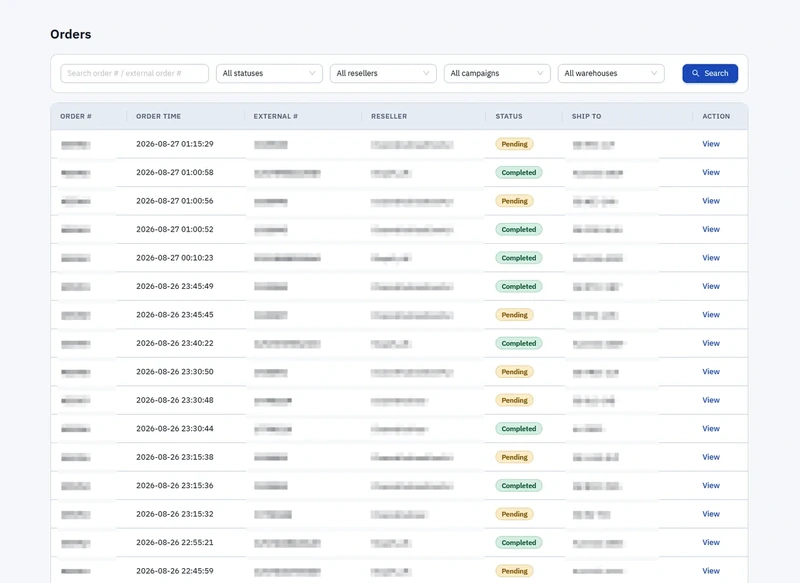
Test the difficult orders as well as the routine ones
Define these acceptance checks for your project before launch. They are scope decisions, not an assumption that every commerce API supports the same behaviour.
- Repeated events
- Send the same order or update twice. Confirm the agreed duplicate checks prevent unintended extra dispatches or invoices.
- Connection failures
- Test an unavailable API, a rejected record and an expired credential. Agree retry behaviour, alerts and who clears unresolved items.
- Partial fulfilment
- Test orders split across shipments or warehouses. Check line quantities, tracking details and when the channel may mark an order complete.
Everau’s existing build provides evidence for retries, review queues and partial-shipment handling. The detailed rules for your stock, cancellations, returns and refunds still need to be scoped and tested against your providers.
Bring your actual channel and warehouse list
We confirm the connection method for each platform: API access, permissions, rate limits, test environment and supported data. A platform name alone is not enough to promise a working integration.
The Everau case identifies its own-store, marketplace, reseller and third-party warehouse connections by category. We do not publish its private channel or provider list. Its implementation is project evidence, not a claim that tPanel has an off-the-shelf connector for every provider.
- List each sales channel, warehouse and system that owns stock.
- Provide representative order formats and the exceptions staff handle today.
- Identify access owners, peak volumes and acceptable sync delays.
- Separate the first workflow from later returns, refunds or extra-channel work.
Development scope, budget and delivery
These are tPanel’s indicative integration development fees. We confirm the scope, acceptance checks and fixed quote before work begins.
- A$3,000–6,000
- A focused integration or data sync between two platforms. The API, fields and exception requirements determine whether it fits this range.
- A$12,000–45,000
- A multi-system integration with business rules, exception handling and monitoring features. More channels or complex workflows can exceed the range.
Development fees exclude GST, hosting and third-party charges. Ongoing maintenance is agreed separately. A separate storefront, historical data cleanup, returns workflow or new connector is included only when written into the scope.
Agree the schedule around the first complete workflow
The schedule depends on API access, mapping, provider test environments and user acceptance. Everau’s first version took about eight weeks in 2020; that history is not a delivery commitment for a new project.
You own the agreed source code and IP. Agree access, operational handover, monitoring ownership and support before launch. You can use your own hosting and maintenance provider; see our optional managed software plan if you want tPanel to handle it.
E-commerce integration questions
Start with the order handover that causes the most work.
Is this a ready-made order management subscription?
No. This is a scoped custom development service. If an existing order management product covers your needs, compare that option before funding a custom build.
Can we keep our current store and warehouse?
That is the starting point. We review the interfaces and permissions available in the systems you use. The agreed scope records what can connect, what remains manual and any provider changes needed.
Do you also build Shopify storefronts?
Yes. Storefront design and theme development are covered by Shopify development. This page covers order, stock and fulfilment connections behind a store.
What happens when a warehouse API changes?
Agree monitoring, alert ownership and a maintenance arrangement before launch. An API change may require connector updates and testing. Ongoing maintenance and new development are separate from the initial build fee.
Can we start with one channel?
Yes. A useful first release can connect one channel and one warehouse through the full order-to-tracking flow. Additional providers still need their own mapping, access and acceptance tests.
What should we send for a quote?
Send your channel and warehouse list, approximate daily and peak order volume, the current manual steps and target date. We then agree how to review sample records and technical access.
Map your order workflow with us
Tell us your sales channels, warehouses, approximate order volume and the handover that takes the most work. We will review the connections and agree a scope and quote.
Related services and evidence
Last updated 19 September 2026 · tPanel Solution