By Tim Wang · Development Manager, tPanel · LinkedIn ↗ · Updated August 2026
Off-the-shelf software wins when your need is standard, common and well-served by an existing product — it is cheaper to start and faster to use. Custom software wins when your workflow is specific, integration-heavy, or itself a competitive advantage — it fits exactly how you work and you own it. Most businesses end up using both, and the real skill is knowing which problems deserve a custom build and which are perfectly solved by something you can buy today.
This guide compares the two honestly. Off-the-shelf software is not the "cheap" option and custom is not the "premium" option — they solve different problems. We walk through a side-by-side comparison, checklists for each path, the hybrid approach that suits most companies, and a realistic look at total cost of ownership in AUD over three to five years. tPanel builds custom and hybrid systems for Australian businesses, so the advice here is shaped by what actually plays out after launch, not just at the sales stage.
What Is Off-the-Shelf vs Custom Software?
Off-the-shelf software is a ready-made product built once and sold to many customers — think accounting tools, email platforms, project boards and most CRMs. You subscribe or buy a licence, configure a few settings, and use it as designed. It is sometimes called packaged, commercial or SaaS software.
Custom software is built specifically for your business and your process. Instead of adapting how you work to fit a product, the product is shaped around your workflow. It can be a standalone system or a layer that sits on top of tools you already use. tPanel builds these as custom business software — web and mobile systems, internal tools, dashboards and automations designed around one company's way of operating.
The decision between them is the classic "build vs buy" question. Off-the-shelf trades fit for speed and low upfront cost. Custom trades upfront cost and time for a system that matches your process exactly and that you own outright. Everything below helps you weigh that trade for your situation.
Custom vs Off-the-Shelf: Side-by-Side Comparison
The table below compares the two across the dimensions that matter most. There is no column that is "better" everywhere — each path is stronger on some rows and weaker on others.
| Dimension | Off-the-shelf | Custom |
|---|---|---|
| Upfront cost | Low — often free to trial, then a monthly fee | Higher — a project build paid before you see value |
| Time to value | Fast — usable in days or weeks | Slower — weeks to months to design and build |
| Fit to workflow | You adapt to the tool; some processes won't fit | Exact — built around how you actually work |
| Scalability | Scales technically; cost climbs with each seat | Scales on your terms; cost not tied to headcount |
| Integrations | Limited to what the vendor supports | Anything with an API can be connected |
| Ownership / IP | You licence access; you own nothing | You own the code and the IP — it's an asset |
| Maintenance | Vendor handles it; you accept their roadmap | You fund maintenance; you control the roadmap |
| Per-seat cost over time | Recurring per user — grows as the team grows | Usually flat — add users without per-seat fees |
The pattern is clear: off-the-shelf is strongest on speed and upfront cost, custom is strongest on fit, ownership and long-run cost at scale. The next two sections turn that into a yes/no decision.
When Is Off-the-Shelf the Right Call?
For a large share of business needs, buying is simply the right answer. If a proven product already does the job, building your own version is wasted money and risk. Off-the-shelf is the right call when most of these are true:
- Your need is standard and common — accounting, payroll, email, video calls, document storage, basic scheduling.
- An existing product already covers most of your requirements out of the box.
- You can adapt your process to the tool without real pain or lost revenue.
- You need something working now, and speed matters more than a perfect fit.
- Upfront budget is tight and a low monthly fee is easier to justify than a project build.
- The function is not a source of competitive advantage — doing it differently wins you nothing.
Be honest here: many "we need custom" instincts are really off-the-shelf problems in disguise. If a packaged tool gets you 85% of the way and the missing 15% is a minor annoyance, buy the tool. Custom is worth its cost only when that missing slice genuinely holds the business back. For a tighter test on one common case, see our guide on custom CRM vs off-the-shelf.
When Is Custom Software Worth It?
Custom software earns its higher upfront cost when the fit, ownership or integration it provides moves the needle on how you operate or compete. The signs you need custom software tell you that a problem exists; the test below is comparative — it asks whether custom beats buying for this problem. Custom is the stronger choice when, weighed against the best off-the-shelf option, most of these hold:
- Fit gap: the closest packaged tool gets you well under ~80% of the way, and the missing slice is a daily cost rather than a minor annoyance.
- Workaround cost beats build cost: the hours your team loses to manual re-keying, spreadsheets and copy-paste between tools, valued over a few years, outweigh a one-time build.
- Integration is the point: the value is in data moving automatically between systems that don't talk to each other — something no single vendor sells.
- It's a competitive lever: the workflow is part of why customers choose you or how you run leaner than rivals, so matching a rival's off-the-shelf stack actively loses you ground.
- Per-seat economics have flipped: across your headcount, SaaS fees over three to five years exceed a build plus its maintenance (the worked example below shows how to check this).
- Ownership genuinely matters: you need the system as an asset, control of the roadmap, and protection from a vendor's pricing or shutdown decisions — not just a nice-to-have.
If only one or two of these hold, buy or adapt a packaged tool. Common custom builds include a custom CRM shaped around an unusual sales process, internal operations tools, customer portals, and full SaaS platforms where the software is the product you sell.
The risk on the custom side: delivery and overrun
An honest comparison has to name custom's main downside. A build is a project, and projects can run over time and budget — most often when the scope is unclear at the start. Off-the-shelf has near-zero delivery risk because someone already built and shipped it; custom carries that risk on your side of the table. This is not a reason to avoid custom — it's a reason to de-risk it. Two practices do most of the work: a paid discovery phase that pins down scope, edge cases and integrations before the main build is quoted, and phased delivery that ships a small, usable slice early, so you see value and can correct course long before the full budget is committed. A supplier quoting a large fixed build with no discovery is the real warning sign — not custom software itself.
There is also a cost that never appears on the invoice. A standard SaaS product imposes its own workflow, and wherever that workflow does not match how your business actually runs, your team absorbs the gap — with workarounds, double entry and steps done outside the system. Those small frictions repeat every day and quietly drag on productivity. The one feature you genuinely need is often locked behind a higher tier or a paid add-on, so you end up paying for a whole bundle just to get a single capability. Custom software runs the other way: it is built around your process, leaves out what you do not need, and adds exactly what off-the-shelf will not.
The Hybrid Approach: Custom Built Around SaaS
The choice is rarely all-or-nothing. The approach that suits most businesses is a hybrid: keep proven off-the-shelf tools for commodity functions, then build custom only where your process is unique. You don't rebuild email or accounting — you build the layer that ties everything together and handles the work no packaged tool does well.
Keep the commodity SaaS
Proven platforms stay where they already work — accounting, payroll, email, and even your e-commerce engine. There's no advantage in rebuilding these, and the vendors maintain them for you. Example: an online retailer keeps Magento running its storefront and product catalogue rather than replacing the platform.
Build the custom layer
A custom system handles the parts the platform does badly or not at all, and becomes the place your team actually works. Example: that retailer runs a custom admin built over Magento's database — bulk product uploads and stock updates from Excel, a drag-and-drop newsletter builder with one-click send, and automatic supplier stock feeds — work that took three to five staff now done by one.
Connect with integrations
System integration wires the custom layer to everything else, so data flows automatically instead of being copied by hand. Example: the same admin reads and writes Magento's database directly, pulls stock updates from suppliers, and embeds Zoho's helpdesk so support tickets are handled in the one back office.
This model gives you the reliability and low maintenance of SaaS for the boring parts, and the exact fit of custom only where it pays off. It also keeps the build smaller and cheaper, because you're not reinventing tools that already work. A hybrid often starts as a thin custom layer plus a few integrations, then grows as you find more processes worth absorbing.
Total Cost of Ownership Over 3–5 Years
Comparing only the upfront price is misleading. The fair comparison is total cost of ownership over three to five years, and here the two paths behave very differently — so be honest about which one your numbers actually favour.
Off-the-shelf looks cheap on day one but charges per seat, every month, forever. Business SaaS commonly sits in an illustrative range of roughly A$30–A$100 per user per month depending on the tool and tier — always check current pricing, since vendors change tiers often. That is modest for five people but becomes a serious line item across thirty or fifty, and prices tend to rise over time. There's little upfront risk, but the bill never stops and grows with the team.
Custom software front-loads the cost. A small single-workflow build typically lands around A$3,000–6,000; a fuller custom system (a custom CRM, internal/ops system or integration-heavy build) typically runs A$12,000–45,000, with large multi-system or SaaS platforms at A$50,000+. After the build you pay a flat monthly maintenance fee — around A$1,000 a month (about A$12,000 a year) with the included work defined in the agreement. This is not a per-seat licence fee; hosting, external services and work outside the maintenance scope need to be checked separately. Our guide on custom software cost in Australia breaks the figures down further.
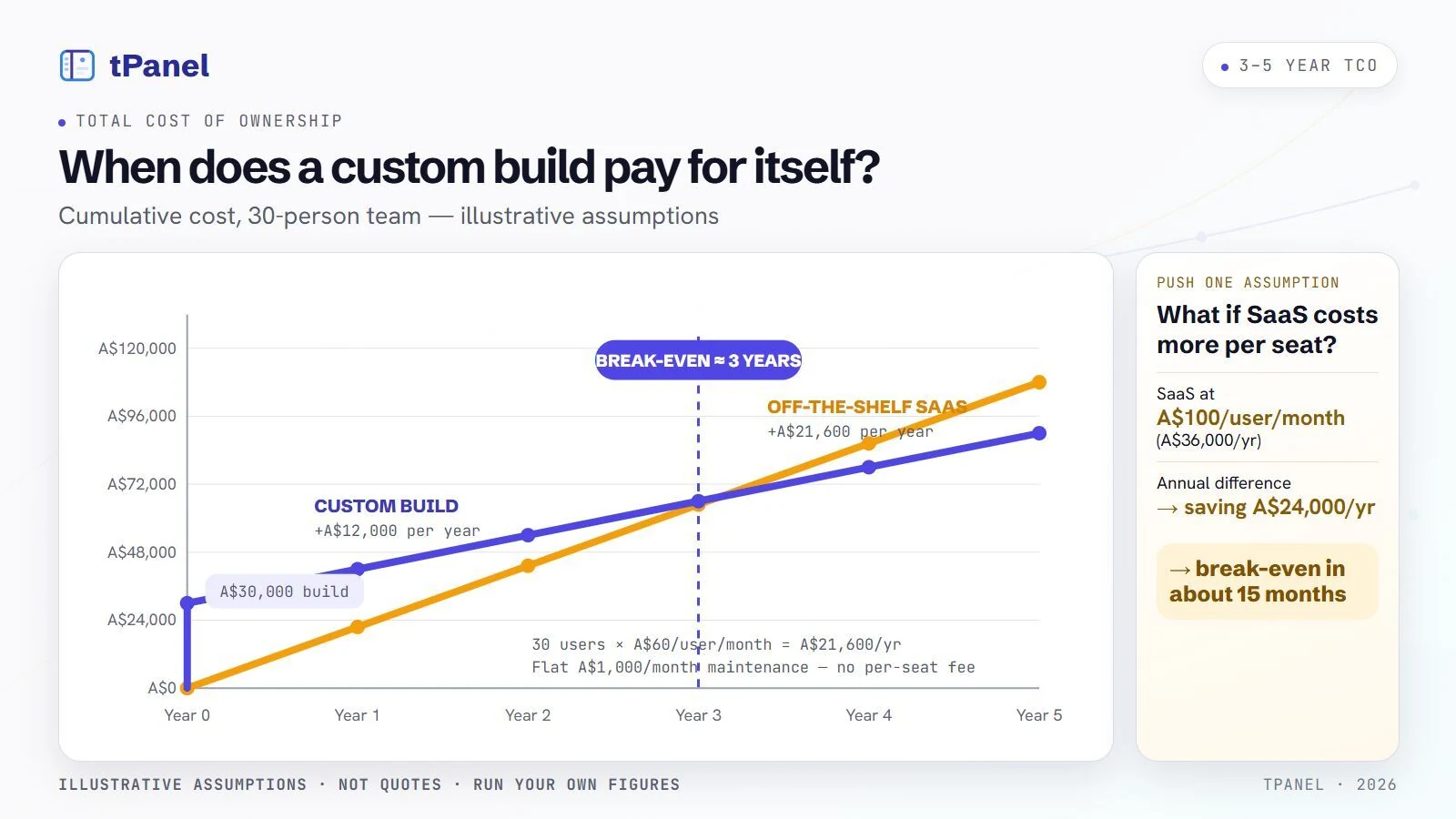
Worked example: a break-even (all figures illustrative assumptions)
Plug in your own numbers — these are assumed, not quotes:
- Assume a 30-person team on SaaS at A$60 per user per month (mid of the illustrative range above).
- SaaS cost per year: 30 × A$60 × 12 = A$21,600/year — and it rises with every new hire.
- Assume a custom build of A$30,000 (a mid-size system) that replaces that tool.
- Assume A$12,000/year for custom maintenance against A$21,600/year in SaaS licence fees: a difference of A$9,600/year. This is not the net saving after all running costs.
- Under these assumptions, A$30,000 ÷ A$9,600 = 3.125 years (about 38 months). This compares the build with the licence-versus-maintenance difference only, before other costs.
Costs not modelled above: setup and data migration for either option; training; custom hosting and storage; paid APIs, AI usage and other subscriptions; and later changes outside the maintenance agreement. Add one-off items to the upfront total and recurring items to each year. Use the same GST basis for both proposals and confirm whether quoted prices include it. The A$12,000 maintenance assumption is not an all-inclusive operating budget.
Recalculate when user numbers or subscription prices change, and check whether custom hosting, service usage or support also increases. For example, an assumed extra A$3,000 a year on the custom side, with SaaS costs unchanged, reduces the annual difference from A$9,600 to A$6,600 and extends the calculation to about 4.5 years. This is an illustration, not a forecast.
So which wins? For a small team on cheap SaaS, off-the-shelf almost always stays cheaper — don't build to save money you weren't spending. For a larger team paying premium per-seat fees, or a business where the manual workarounds around an ill-fitting tool cost real labour, custom can pull ahead within a few years and keep widening the gap after that. Run both as a five-year cash-flow projection before deciding; the upfront number alone will mislead you in either direction.
The biggest number is on neither bill.
Licence fees versus build cost is only the visible comparison. For most businesses the largest expense is labour, not software — and the real purpose of a custom system is to save it. A system shaped around your actual workflow removes manual re-keying, chasing and the workarounds an ill-fitting tool forces, giving each person hours back every week. Valued across a team, that recovered time usually dwarfs the difference in software cost. The subscription saving is a bonus; the labour saving is the real case for building.
A real example. A tPanel client prepares product quotes for large online deal and marketplace platforms (the kind run by OzSale, Catch and Groupon). Their selection, product imagery and pricing used to be a manual back-and-forth between a local team and an overseas one: the overseas team assembled files into a shared cloud drive, the local team opened each document, checked the images and prices, made adjustments, then sent the result to the platform — and every single product quote took a long time. tPanel built a custom system that pulls the product images, generates the quote file, lets the team adjust pricing and sends it to the platform automatically, while recording cost and order data so a profit report falls out at the end. It cut the time spent on that daily repetitive work by around 80% and gave the business a far more structured process. The build was paid for once; the labour it returns comes back every day.
A Short Decision Checklist
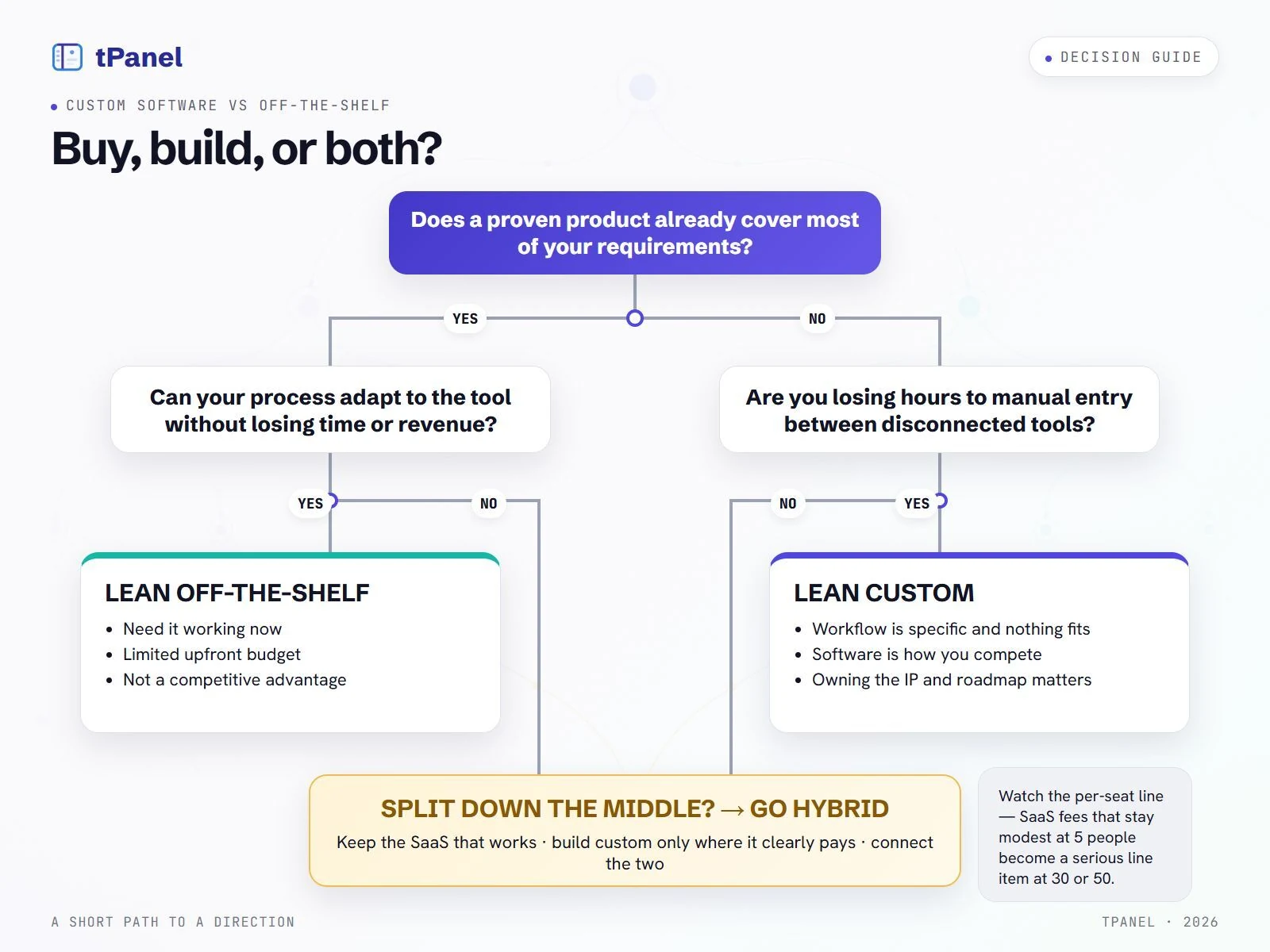
Use this to land on a direction quickly. The more boxes that point one way, the clearer the call.
Lean off-the-shelf if:
- A proven product already covers most of your requirements.
- Your process can adapt to the tool without losing time or revenue.
- You need it working now and upfront budget is limited.
- The function isn't a source of competitive advantage.
- Your team is small enough that per-seat fees stay modest.
Lean custom (or hybrid) if:
- Your workflow is specific and no off-the-shelf tool fits it well.
- You're losing hours to manual data entry between disconnected tools.
- The software is part of how you compete or run leaner than rivals.
- Per-seat SaaS fees have grown large across a bigger team.
- Owning the system, the IP and the roadmap genuinely matters.
If you're split down the middle, the hybrid path is usually the safe answer: keep the SaaS that works, build custom only where it clearly pays, and connect the two. tPanel helps Australian businesses make this call honestly — including telling you when you don't need a custom build at all.
Frequently asked questions about custom vs off-the-shelf software
Can’t see your question here? Tell us what you’re trying to build and we’ll answer it directly — no sales script.
Is custom software better than off-the-shelf?
Neither is better in every case. Off-the-shelf software is better when your need is common and well-served by an existing product, because it is cheaper upfront and faster to start using. Custom software is better when your workflow is specific, integration-heavy, or a competitive advantage, because it fits exactly how you work and you own it. The right choice depends on how unusual your process is and how central the software is to how you make money.
Is custom software always more expensive?
No. Custom software almost always costs more upfront, but over three to five years the comparison narrows. Off-the-shelf tools charge per seat every month, and that bill grows as you add staff and upgrade tiers. Custom software is largely a one-time build cost plus ongoing maintenance, which does not scale with headcount the same way. For a large team on expensive per-seat plans, custom can be cheaper in the long run; for a small team, off-the-shelf usually stays cheaper.
Can I use custom software and SaaS together?
Yes, and it is often the smartest approach. You keep proven off-the-shelf tools for commodity functions like email, accounting and payroll, then build a custom layer only where your process is unique. System integration connects the two so data flows automatically instead of being re-keyed by hand. This hybrid model gives you the speed and reliability of SaaS with the exact fit of custom only where it matters.
When is off-the-shelf software enough?
Off-the-shelf is enough when your need is standard and common, when an existing product already covers most of your requirements, when you can adapt your process to the tool without much pain, and when speed and low upfront cost matter more than a perfect fit. Accounting, payroll, email, video calls and document storage are good examples where building custom rarely makes sense.
Who owns the software and IP if it is custom-built?
With custom software you own the result. A well-written development agreement assigns the intellectual property and source code to you, so the system is an asset on your side of the ledger. tPanel hands over the source code and documents the build so you are never locked to a single supplier. With off-the-shelf SaaS you are licensing access, not owning anything, and you keep paying for as long as you use it.
Not sure whether to build or buy?
Tell us your process and the tools you use now. We'll give you an honest read on whether off-the-shelf is enough or a custom build pays off.