PHP Development
Built Around Your Business
We build PHP and Laravel business applications for Australian teams, including CRMs, customer portals and integrations. Explore the technology and see our delivered projects.
What is PHP?
PHP is an open-source programming language used extensively for web development. It usually runs on a server: it receives a request, applies business rules, reads or writes data, and returns a web page or an API response. The browser displays the result rather than the PHP source code.
For a business application, that can mean checking who may see a sales lead, saving an order, calculating an account balance or sending an update to a warehouse. PHP can also run scheduled tasks and command-line jobs outside a browser.
- The language
- PHP provides the instructions and data types used to write application logic.
- The framework
- Laravel or CakePHP provides a structure and reusable tools for building the application.
- The platform
- WordPress or Drupal provides a content management system that can be configured and extended.
- The business system
- Your CRM, portal or integration combines that foundation with the workflows your team needs.
PHP is one part of a stack. A database stores records, frontend code provides the interface, and hosting runs the application. See the official PHP site for the language and its releases.
PHP vs Java, TypeScript and Python
All four can support web applications. The useful comparison is between complete stacks and the teams maintaining them, not a language name alone. Here, PHP means a typical Laravel application, Java means a Spring-based backend, TypeScript means a Node.js backend, and Python means a web framework such as Django or FastAPI.
| Stack | Where it is a strong fit | Trade-off to consider |
|---|---|---|
| PHP / Laravel | Business web applications, customer portals, CMS extensions and database-led workflows. Laravel brings many common application tools together. | Specialist data science or model training usually benefits from a separate Python service. Real-time connections and heavy background work still need suitable workers and infrastructure. |
| Java / Spring | Established Java organisations, long-lived backend services and systems that benefit from the JVM ecosystem and compile-time type checking. | A small standalone web project may not benefit from adopting a JVM stack if the team already delivers and supports PHP well. Java is not automatically more scalable or more expensive. |
| TypeScript / Node.js | Teams wanting JavaScript-based development across the frontend and backend, with static type checking and an ecosystem suited to event-driven services. | TypeScript types do not validate untrusted data at runtime. CPU-heavy work can block Node's event loop unless it is moved to workers or another service. |
| Python / Django or FastAPI | Applications closely tied to data analysis, scientific computing, machine learning or an existing Python team. | For PHP CMS work or a maintained Laravel codebase, switching to Python adds migration work. A data service can often connect to the existing application instead. |
Our recommendation: consider PHP when the main challenge is delivering a business web workflow and its integrations. Prefer another stack when your existing team, software estate or specialist workload makes it a better fit. Neither price, security nor speed can be ranked reliably from the language name alone.
Reference points: Spring Boot, TypeScript's role, Node.js event-loop guidance and Python applications. The project-fit comparisons above are our practical assessment, not benchmark results.
Which PHP framework is most popular?
Laravel led framework usage in JetBrains' State of PHP 2025 survey. Of 1,720 respondents who named PHP as their main language, 64% reported Laravel usage; Symfony was reported by 23%. That makes Laravel a well-supported answer when a buyer asks which PHP framework to consider first.
These are survey usage figures, not the share of every website or a measurement of the Australian market. Respondents may use more than one tool. The same report includes WordPress, but WordPress and Drupal are content management systems rather than direct equivalents to Laravel.
Symfony is another established PHP framework. CakePHP, CodeIgniter and Yii also appear in the survey. The right choice depends on the existing application, its dependencies and who will maintain it. For tPanel's custom business applications, Laravel is the focus of our published PHP project work.
What Laravel adds to a PHP application
Laravel is an open-source PHP framework. It supplies common building blocks such as request routing, database access, validation, authentication tools, queues and testing support. That lets a project concentrate more of its effort on the business rules and interfaces that are specific to the customer.
- Users and access
- Structure sign-in and authorisation, then define and test what each role is allowed to do.
- Records and workflows
- Model customers, leads, products or orders and validate changes before storing them.
- APIs and background jobs
- Connect external systems and process tasks such as imports or notifications outside a user's immediate request.
- Testing and maintenance
- Check critical workflows as the application, framework and dependencies change.
The framework supplies tools; the application still needs correct access rules, sensible database design, reliable integrations and operational care. Installing Laravel does not make a system secure or scalable by itself.
tPanel uses Laravel for CRM development, customer portals, SaaS platforms and integrations. The official Laravel documentation describes the framework's capabilities.
Particle: a Laravel sales CRM
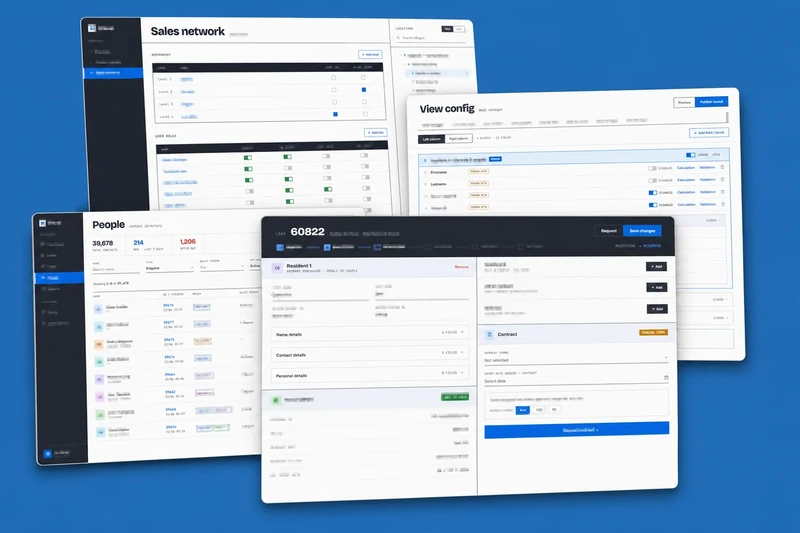
tPanel built Particle Sales Accelerator with a Laravel backend, MariaDB, a React web interface and a companion mobile app. The system supports sales teams with lead allocation, permissions, follow-up and reporting.
Its published case study explains how one application serves multiple organisations with separate tenant databases, background workers and independently operated web and API server pools. The backend moved to Laravel 13 and PHP 8.4 in 2026.
- Business workflow: assign leads and track the next sales action.
- Application structure: tenant access, database routing and background processing.
- Continued development: backend updates and a rebuilt Flutter mobile app.
Everau/Tangwealth: PHP connecting orders and warehouses
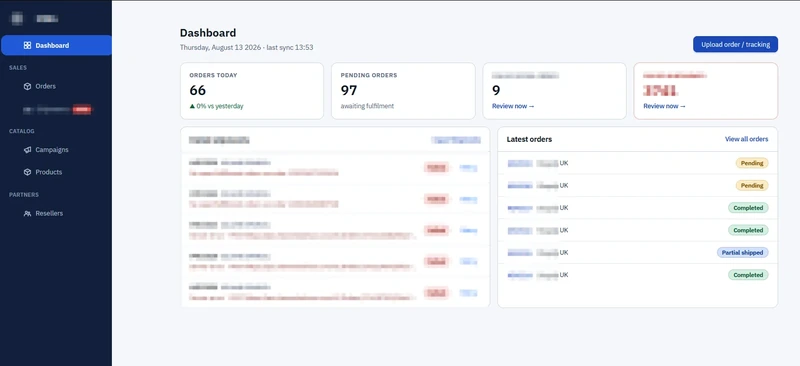
Everau/Tangwealth's IMBA/Order Hub uses PHP, Laravel and MySQL to connect sales channels with warehouse workflows. It gives staff one place to work with orders and follow their progress across the connected systems.
A wholesale customer workflow adds a dedicated login, administrator-controlled product access and pricing, order submission, and approval or rejection by staff. This is a concrete example of a custom application extending the business process around an online store.
- Operations: orders and fulfilment information across connected channels.
- Customer access: wholesale buyers submit orders and check progress.
- Staff control: administrators manage available products and review orders.
We also work with CakePHP, Drupal and WordPress
Laravel is our main focus here, but PHP work does not always mean a new Laravel application. We can also discuss development, extensions, integrations and maintenance for CakePHP, Drupal and WordPress. We review the existing version, modules or plugins and the change you need before agreeing the scope.
- CakePHP applications
- Develop or extend business workflows in the existing framework, connect APIs and review upgrade requirements. CakePHP is a PHP application framework.
- Drupal websites
- Work with content structures, custom modules and integrations, or plan changes to an existing Drupal site. Drupal is a content management system.
- WordPress websites
- Build and extend business websites, plugins and connected workflows. Our WordPress development page covers that service in more detail.
- Existing custom PHP
- Review the application and its dependencies, then decide what to maintain, improve or replace. A framework migration is a scope decision, not a default.
For an application that needs fixes, a handover or a version upgrade, see PHP and Laravel maintenance support. Framework and platform references: CakePHP, Drupal and WordPress.
Discuss the workflow, then agree the scope
Tell us what your users need to do, what exists today and which systems must connect. Tim Wang, tPanel's owner and full-stack developer, stays hands-on with scoping, development and maintenance.
We quote the agreed development scope. Testing, migration, hosting, third-party fees and ongoing support need clear boundaries. You own the agreed source code and IP. Our cost guide gives planning context; our developer hiring guide explains how to compare suppliers.
PHP development questions
Is PHP only for simple websites?
No. PHP can support custom web applications, APIs and background work as well as content websites. Our Particle and Everau/Tangwealth case studies show business applications built with PHP and Laravel. Architecture, testing and operations determine how well an application meets its requirements.
Is Laravel the same thing as PHP?
No. PHP is the language. Laravel is a framework written in PHP that supplies reusable application tools and structure. WordPress and Drupal are PHP-based content management systems, while CakePHP is another application framework.
Should we replace Java, TypeScript or Python with PHP?
Not simply because PHP is available. Start with the current application, team and business requirements. Retaining a working system and connecting it to a new service may involve less disruption than rewriting it.
Can you help with old PHP or Laravel software?
Yes. We can review the application, dependencies and deployment access, then agree a plan for fixes, handover, upgrades or ongoing support. Our PHP and Laravel support page explains the review and upgrade approach.
Can PHP and Python work together?
Yes. A PHP application can call a Python service through an API or exchange work through a queue. This can keep customer workflows in the existing application while a separate service handles a specialist data task. The integration and failure handling still need to be designed.
Tell us what your application needs to do
Describe the business workflow, the people who use it and the systems it must connect to. We will discuss the scope and the next step.
Working with us from another city? See how we communicate, arrange on-site visits and quote projects.